United States Capitol Rotunda ✶ 180 Feet Above the Floor
The Apotheosis
of Washington
The ascension of a mortal to the realm of the gods
Explore
The ascension of a mortal to the realm of the gods
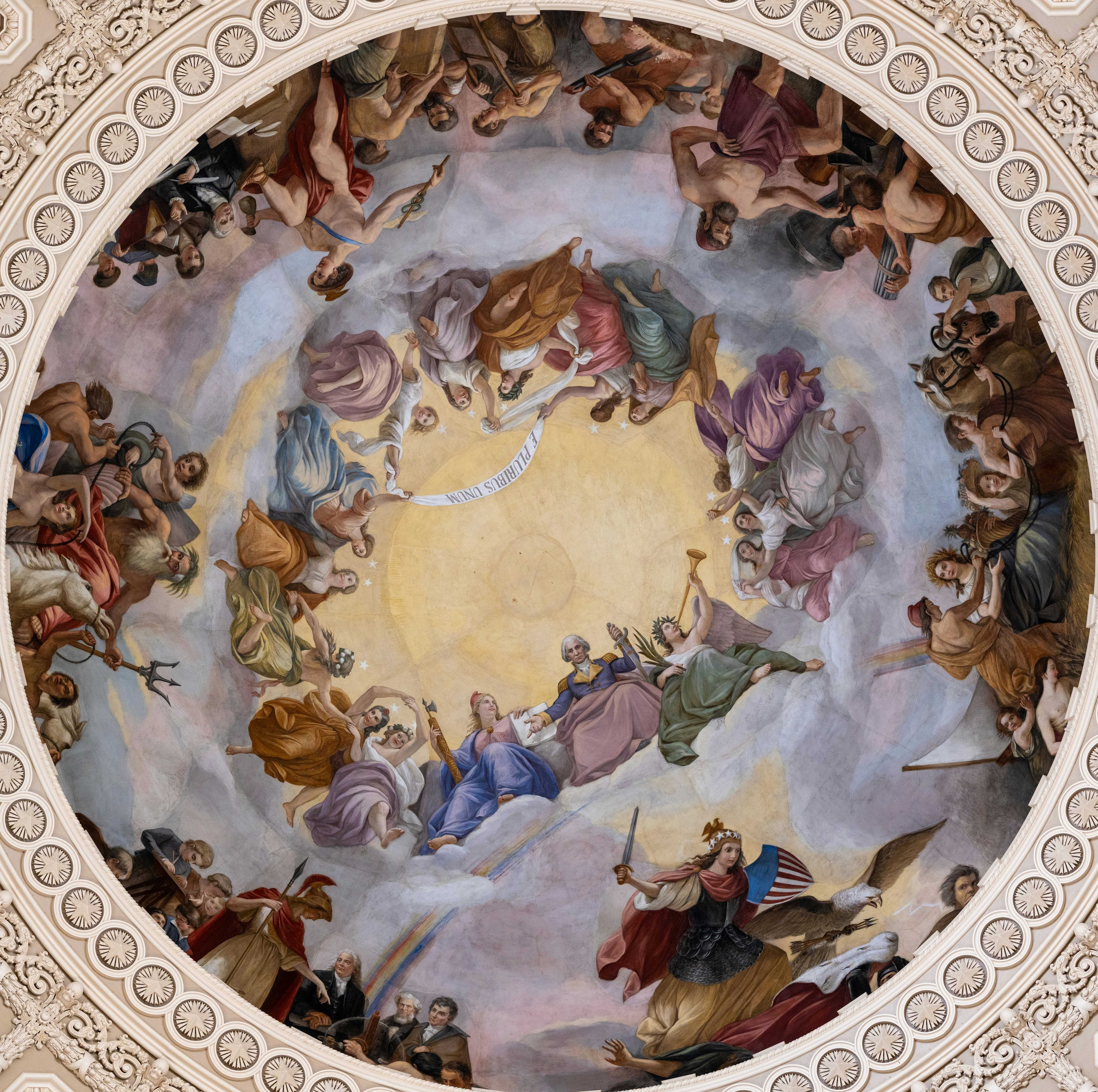
Suspended 180 feet above the Rotunda floor, covering 4,664 square feet of concave canopy, the Apotheosis of Washington depicts George Washington ascending to divine status — literally becoming a god. The word "apotheosis" comes from the Greek apotheoun: to deify.
Painted in true fresco — pigment applied directly into wet plaster — by the Italian-Greek artist Constantino Brumidi in 1865, the work transforms the interior of the Capitol dome into a celestial theater. The figures are up to 15 feet tall so they can be read from the Rotunda floor far below, yet when seen from scaffolding height, every face is rendered with portrait-level precision.
Brumidi completed the entire canopy fresco in just 11 months, working through the final year of the Civil War. He was paid $40,000 — roughly $800,000 in today's dollars. He had trained under Pope Gregory XVI at the Vatican, restoring Raphael's Loggia, and brought that same mastery of di sotto in su (seen from below) perspective to the American republic.
At the apex of the dome, Washington sits enthroned on clouds, draped in royal purple — the color of a Roman general in triumph. A rainbow arcs beneath his feet. He is flanked by two female figures and encircled by thirteen maidens.
Washington is depicted in a pose borrowed from classical apotheosis imagery — seated in majesty, one arm raised in a commanding gesture, the other resting on a sheathed sword. He wears the purple robes of a triumphant Roman imperator, not the uniform of an American general. The rainbow beneath him symbolizes the bridge between mortal and divine realms, a motif drawn from both classical mythology and Freemasonic symbolism.
To Washington's right sits the female embodiment of Liberty. She wears a red Phrygian liberty cap — the pileus worn by freed Roman slaves — and holds a fasces (a bundle of rods symbolizing republican authority and the strength of union). Before her rests an open book, likely representing the Constitution or the rule of law.
To Washington's left, a winged figure in green robes blows a long trumpet and holds a palm frond. She is either Victory heralding triumph or Fame proclaiming Washington's glory to eternity. Her trumpet sounds across the heavens, announcing the deification.
Encircling the central trio, thirteen young women each bear a star above their head, representing the original thirteen colonies. They hold a draped banner reading E Pluribus Unum — "Out of many, one." Several of the maidens turn their backs to Washington, which has been interpreted as representing the states that had seceded during the Civil War, painted at the very moment the war was ending.
Ringing the central group like petals of a celestial flower, six scenes depict the classical gods bestowing their gifts upon America. Each scene pairs a Roman deity with real American historical figures, fusing ancient mythology with the young republic's identity.
The most dramatic scene. Columbia — also called Freedom or Armed Liberty — stands atop a cannon in a starred, striped cape, sword raised. An American eagle grasps arrows and thunderbolts beside her. Together they vanquish the figures of Tyranny and Kingly Power, who flee in terror. Tyranny is depicted with a crown and torch of discord. This scene directly references the victory over monarchy and the revolutionary ideal.
Minerva, helmeted and bearing her shield and spear, teaches inventors and scientists. Beside her stand three real Americans: Benjamin Franklin with his kite and key, Samuel F.B. Morse with his telegraph, and Robert Fulton with a model of his steamboat. An electrical generator sits at Minerva's feet. This scene celebrates American ingenuity as divinely sanctioned, the practical arts blessed by the goddess of wisdom herself.
Neptune rides his chariot of sea horses, trident in hand, commanding the ocean. Beside him, Venus — born from sea foam — helps lay the transatlantic telegraph cable, connecting the Old World to the New. An ironclad warship is visible in the background, asserting American naval power. Cupids or putti swim alongside. The scene celebrates American mastery of the oceans and the technological triumph of transatlantic communication completed in 1866, just a year after the painting.
Mercury, winged-footed messenger of the gods and patron of merchants, hands a caduceus and a bag of gold to Robert Morris, the "Financier of the Revolution" who personally bankrolled the Continental Army. Men move boxes and crates of goods in the background. The scene glorifies American capitalism and trade as sacred activities, blessed by the divine patron of commerce.
Vulcan stands at his anvil, hammer raised, foot resting on a cannon barrel. A steam engine sits behind him. Beside him is Charles Thomas, who designed the dome's ironwork construction. This scene celebrates American industrial might — the forges, foundries, and engines that were winning the Civil War and building the transcontinental railroad. Vulcan's fire is America's forge.
Ceres, wreathed in grain and draped in flowing robes, sits atop a McCormick mechanical reaper — the machine that revolutionized American farming. Young America, wearing a liberty cap, stands beside her. Flora gathers flowers nearby. The scene unites the ancient goddess of agriculture with the cutting-edge technology of the 1860s, suggesting that American abundance is both divinely blessed and mechanically assured.
"The Michelangelo of the United States Capitol" — a Greek-Italian artist who trained in the Vatican, fled political persecution, and devoted 25 years of his life to painting the Capitol.
Born in Rome to a Greek father and Italian mother. Named Constantino, a nod to the Emperor Constantine.
Trained at the Accademia di San Luca in Rome. Worked under Pope Gregory XVI, restoring Raphael's Loggia in the Vatican Palace and painting frescoes in Roman palaces. Mastered the true fresco technique (buon fresco) — painting into wet plaster so pigment and wall become one.
Participated in the short-lived Roman Republic and was imprisoned after its collapse. After release, emigrated to the United States in 1852.
Hired by Captain Montgomery C. Meigs to decorate the new extensions of the Capitol. Began painting the corridors, committee rooms, and Senate chambers in elaborate classical style — the "Brumidi Corridors."
Commissioned to paint the canopy fresco of the new Capitol dome. Worked on scaffolding 180 feet above the Rotunda floor. Completed the Apotheosis in approximately 11 months, finishing in 1865 as the Civil War ended and Lincoln was assassinated.
At age 74, while painting the frieze band that encircles the Rotunda below the canopy, Brumidi slipped from his scaffold and hung from a railing for 15 minutes before being rescued. He never fully recovered and died on February 19, 1880. The frieze was completed by Filippo Costaggini and later Allyn Cox.
Washington was initiated into Freemasonry in 1752 at Fredericksburg Lodge No. 4 in Virginia. He served as Worshipful Master and laid the Capitol cornerstone in a Masonic ceremony wearing a Masonic apron. The Apotheosis is saturated with Masonic symbolism.
The concept of a mortal ascending to divine understanding mirrors the Masonic journey through degrees — from Entered Apprentice through Master Mason. The candidate metaphorically "dies" and is "raised" to higher knowledge. Washington's ascent in the fresco is the supreme expression of this idea applied to an entire nation.
The circular composition with Washington at its center echoes the Masonic circumpunct — a point within a circle — one of the most ancient symbols in Freemasonry representing God, the sun, and the relationship between the individual and the infinite. Dan Brown made this the central mystery of The Lost Symbol, set entirely in the Capitol.
The rainbow beneath Washington's feet is the Royal Arch — a central symbol in York Rite Masonry. It represents the bridge between the earthly and the celestial, the covenant between humanity and the divine. In the fresco it literally supports Washington as he crosses from mortal to god.
The thirteen maidens each hold a star — five-pointed, a pentalpha. In Masonic tradition, the blazing star represents divine providence and the light of knowledge. Thirteen is the number of transformation, death and rebirth. The number recurs throughout early American symbolism: 13 colonies, 13 stripes, 13 arrows, 13 olive leaves.
The painting of the Apotheosis of Washington is not merely decorative — it is the visual theology of a Masonic republic. Washington is shown not as a Christian saint ascending to heaven, but as an Enlightenment hero elevated by Reason, Science, and Liberty to a plane of divine understanding.
Steven C. Bullock, Revolutionary Brotherhood
The timing of the Apotheosis is extraordinary. Brumidi painted through the final convulsions of the Civil War — the bloodiest conflict in American history. While he worked 180 feet above the Rotunda floor, Lincoln was assassinated in Ford's Theatre less than two miles away (April 14, 1865). The dome itself was completed in December 1863 as a deliberate symbol that the Union would endure.
Lincoln insisted the Capitol construction continue throughout the war. "If people see the Capitol going on," he said, "it is a sign we intend the Union shall go on." The dome — engineered by Thomas U. Walter using nearly 9 million pounds of ironwork — was topped by the Statue of Freedom on December 2, 1863, to a 35-gun salute.
Brumidi's fresco, completed inside that dome in 1865, became the celestial ceiling of a reunified nation. The turned-back maidens — representing the seceded states — face away from Washington but remain within the circle. They are not expelled. The message: the Union is eternal, even when some of its members falter.
If people see the Capitol going on, it is a sign we intend the Union shall go on.
Abraham Lincoln, 1863
Unlike oil painting on canvas, true fresco (buon fresco) involves applying water-based pigment directly into freshly laid wet lime plaster. As the plaster dries, the pigment chemically bonds with the calcium carbonate, becoming part of the wall itself.
This technique demands extraordinary speed and precision. The artist can only paint the area of wet plaster laid that day (called a giornata — literally "a day's work"). Once the plaster dries, no corrections are possible. Every brushstroke must be final. Brumidi, trained in this method at the Vatican, was one of the last great masters of the technique.
The concave surface of the dome presented unique challenges. Brumidi employed di sotto in su ("seen from below") perspective — the same technique Correggio and Andrea Mantegna used in Italian cathedral domes. Figures at the edges are dramatically foreshortened; limbs project outward toward the viewer. From 180 feet below, the illusion is seamless — the dome appears to open into heaven itself.
The canopy is 65 feet in diameter. The figures are painted at heroic scale — up to 15 feet tall — so they remain legible from the Rotunda floor. Despite this enormous scale, Brumidi rendered faces, hands, and fabric folds with the detail of an easel painting. Visitors who have seen the fresco from scaffolding height report being stunned by the precision visible up close.
The Apotheosis plays a central role in Dan Brown's 2009 novel The Lost Symbol, where protagonist Robert Langdon is trapped in the Capitol Rotunda and must decode the fresco's Masonic symbolism to prevent catastrophe. Brown argues that the painting is the key to understanding Washington, D.C. as a city designed by Freemasons to encode ancient mysteries in plain sight.
The fresco appears in the film National Treasure: Book of Secrets (2007) and has been referenced in countless documentaries about American Freemasonry, sacred geometry, and the hidden symbolism of Washington, D.C. It remains the largest and most prominent work of art in the United States Capitol.
More than 10 million visitors see the painting each year from the Rotunda floor — most without realizing they are looking at the deification of a mortal man, rendered in the same technique used to decorate the Sistine Chapel, by an artist who once worked for the Pope.