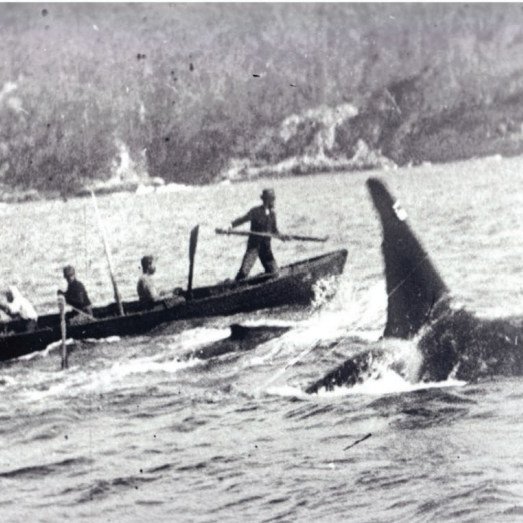
Three o’clock in the morning. Twofold Bay, Australia. 1910.
George Davidson is asleep in his cottage at the mouth of the Kiah River when a sound wakes him — a rhythmic, explosive slapping on the water’s surface, close enough to rattle the windows.
He doesn’t need to look. He knows the signal. He’s been hearing it since he was a boy, and his father heard it before him, and the Yuin people who fished these waters heard it for ten thousand years before that.
Old Tom is calling.
The orcas have found a whale.
The Law of the Tongue
For at least ten millennia, the indigenous Yuin people of the southeastern Australian coast maintained a cooperative hunting partnership with a resident pod of killer whales.
The arrangement was formalized in what the later European settlers would call the Law of the Tongue. The rules were simple: the orcas would herd migrating baleen whales into Twofold Bay, the humans would help kill them, and after the kill, the humans would anchor the carcass and let it sit overnight. During this time, the orcas would eat the tongue and the lips — the choicest parts. In the morning, the humans would collect the rest.
Both sides honored the contract. For thousands of years. Neither cheated. Neither forgot.
This was not instinct. Instinct doesn’t negotiate terms. Instinct doesn’t distinguish between human families. Instinct doesn’t transmit cooperative protocols across hundreds of generations to individuals who have never met a human before.
This was culture. Orca culture. Teaching the young: these are the humans you work with. This is how you signal them. This is what they owe you. This is what happens if they cheat.
The Transfer
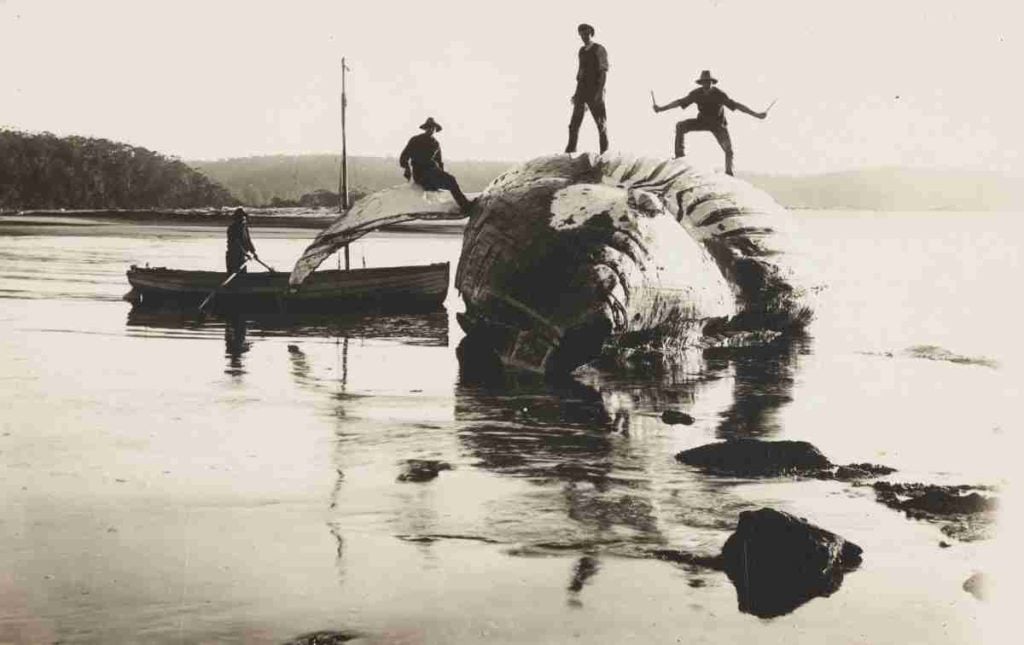
In the 1840s, European settlers arrived at Twofold Bay. Among them was the Davidson family.
What happened next should have been impossible.
The Yuin crew members who worked with the Davidsons introduced them to the orcas. Not metaphorically. They brought the Europeans into the existing cooperative framework. They vouched for them.
And the orcas accepted.
This is not a small thing. The orcas were not simply continuing a behavior pattern that happened to include new humans. They were evaluating new individuals — people they had never encountered, whose scent was different, whose boats were different, whose behavior was different — and making a determination: these ones can be trusted.
Three generations of Davidsons would work with the pod. From the 1860s through the 1920s, the partnership was so reliable that it became the economic foundation of the town.
“Old Tom would swim to the mouth of the Kiah River and slap his tail on the surface — the signal that a whale had been corralled in the bay. He did this for decades. He recognized individual Davidsons.”
Old Tom
Of all the orcas in the pod, one became legendary.
Old Tom — named by the Davidsons, though his Yuin name is lost to history — was the primary liaison between the pod and the human whalers. He was, by any reasonable definition, a colleague.
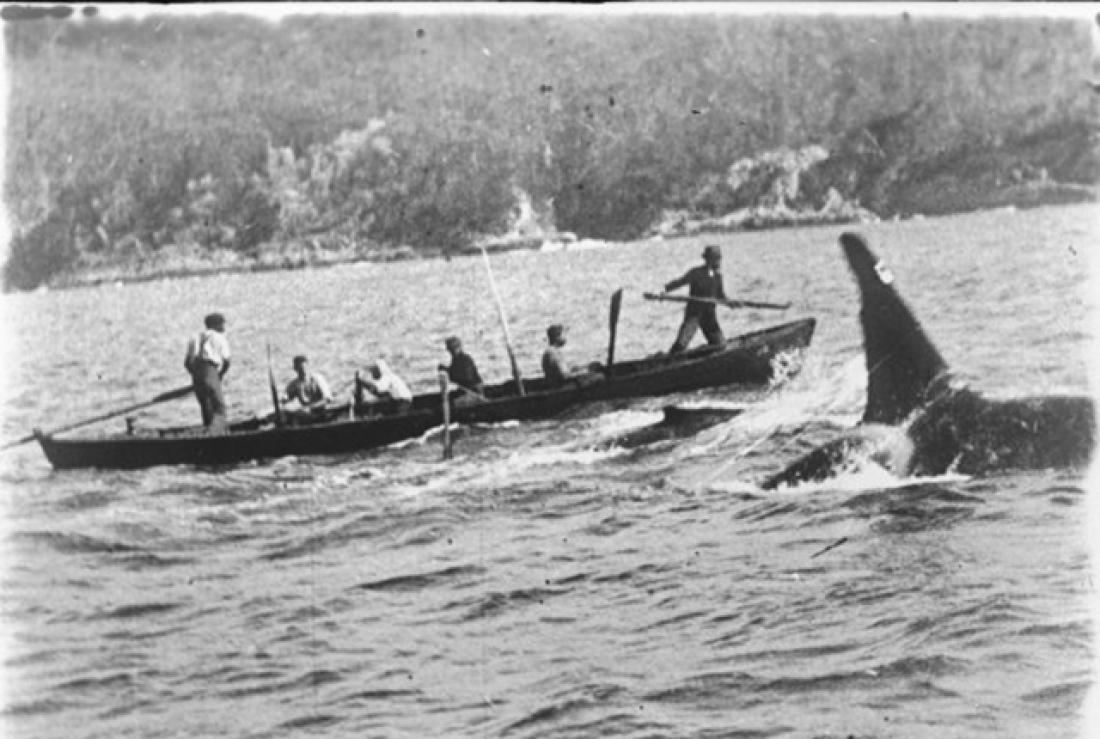
When a baleen whale entered Twofold Bay and the orcas had begun herding it, Old Tom would break away from the pod and swim to the mouth of the Kiah River. There, within earshot of the Davidson home, he would breach and slap his tail on the surface.
He did this for decades. Through storms and calm. In daylight and darkness. He recognized individual Davidsons. He adjusted his signaling based on conditions. When the sea was rough and launching the boats was dangerous, eyewitness accounts describe him swimming closer to shore, as if to confirm the situation warranted the risk.
He was not a trained animal performing a trick. He was a partner making strategic decisions within a cooperative framework that predated European arrival by ten thousand years.
The Betrayal
Around 1923, a man named John Logan — not a Davidson, not part of the lineage that had maintained the relationship — violated the Law of the Tongue.
After a kill, Logan’s crew hauled the whale carcass away immediately, without leaving it overnight. They took everything. The tongue. The lips. All of it.
What followed was documented by multiple witnesses.
The orcas did not forget.
His teeth were broken. Not from age. From holding on.
Old Tom’s Teeth
Old Tom died on September 17, 1930. His body washed ashore at Twofold Bay.
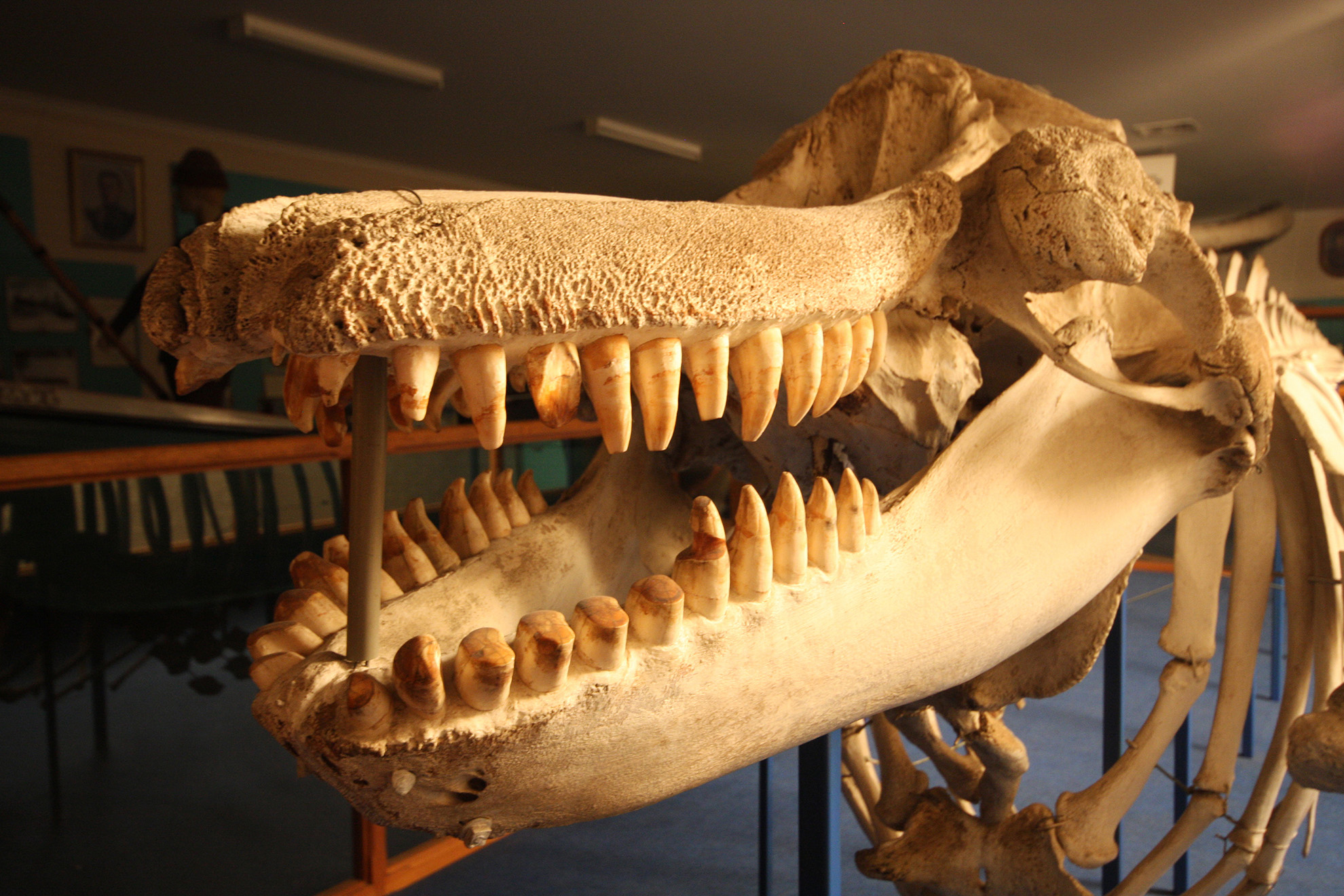
When they examined him, they found something that tells the entire story in bone: his teeth were broken and worn to stumps. Not from age. From a tug-of-war.
At some point in his final years — likely during or after the Logan incident — Old Tom had clamped his jaws onto a rope attached to a whale carcass being hauled away. He had tried to hold on. A seven-ton orca, pulling against a motorized boat, fighting for the terms of a contract his kind had honored for ten thousand years.
His teeth shattered. He kept pulling.
Old Tom’s skeleton is displayed today at the Eden Killer Whale Museum in New South Wales. His broken teeth face visitors like an accusation. They are the physical evidence of what happens when one side of a ten-millennia partnership decides the contract no longer applies.
Ten Thousand Years of Memory
After the Logan incident and the broader collapse of cooperative whaling at Eden, the orca pod gradually withdrew from human partnership. The last confirmed cooperative hunt was in the late 1920s.
The partnership that had endured for ten thousand years ended in a single generation.
But consider what that partnership required. The original Yuin-orca cooperation predates the Egyptian pyramids. It predates Stonehenge. It predates the invention of writing by at least five thousand years.
Across that span, orca mothers taught their calves: these are the humans you work with. This is the signal. This is the deal. The knowledge was transmitted not through genes but through culture — through deliberate teaching, observation, and practice, passed from grandmother to mother to calf across hundreds of generations.
This is not memory as humans typically understand it. It is not the recall of a single individual. It is institutional memory — cultural infrastructure maintained across millennia by beings we still classify as animals.
What They Remember
The Killers of Eden reveal what happens when you take consciousness seriously on more than one axis.
On the symbolic axis — language, math, planning — orcas score moderately. They don’t build cities or write equations.
On the coherence axis — the ability to read intent, verify trust, detect deception across multiple channels — they are extraordinary. Old Tom didn’t just recognize individual Davidsons. He assessed their reliability, adjusted his behavior to conditions, and extended trust to new individuals based on the social introductions of established partners.
On the temporal axis — the ability to encode experience into cultural structures that persist across generations — they may be the most remarkable species on Earth. Ten thousand years. A cooperative protocol maintained and transmitted without writing, without institutions, without any of the tools humans consider necessary for cultural continuity.
The broken teeth in the Eden museum don’t just tell the story of one orca and one betrayal. They tell the story of what we lose when we assume that consciousness lives only in the dimension we happen to dominate.