In the summer of 1965, on the eastern end of a small Caribbean island, a young woman flooded the top floor of a research building with two feet of seawater, set a bed on a platform in the middle of the room, and moved in with a dolphin.
She stayed six days a week, for the better part of a season. She was trying to teach him to talk.
The experiment was funded by NASA. The people who paid for it believed it was a rehearsal — practice for the day we would finally have to speak with a mind that was not human. They were not wrong about the stakes. They were only wrong about which mind was in the room.
The Girl
She was not a scientist. In her early twenties, living on St. Thomas, she heard there was a secret laboratory at the end of the island where they kept dolphins. In early 1964 she drove down a muddy hill, and at the bottom found a white building on a cliff over the sea.1
The man who met her was Gregory Bateson — the anthropologist and cyberneticist, one of the great minds of the century — and he ran the place. He had no use for unannounced visitors, but he was charmed by her nerve. He told her to watch the animals and write down what she saw. She had no training. She turned out to be an unusually good observer, and he told her she could come back whenever she liked.1
There were three dolphins: Sissy, who ran the show; Pamela, who was shy; and Peter, a young male, in her words “sexually coming of age and a bit naughty.” Every night the staff lowered the garage door, got in their cars, and drove away, leaving the animals alone in the dark water. It bothered her. Why let the water get in the way? she thought. So she asked to flood the building and live in it.1
The Lab
The trick that makes it possible — the thing that sounds impossible until you see it — is that a dolphin does not need deep water to survive. It needs two things: to stay wet, and to be able to lift its blowhole to the surface to breathe. Everything else about “a dolphin needs a vast tank” is about room to swim, not about staying alive.2
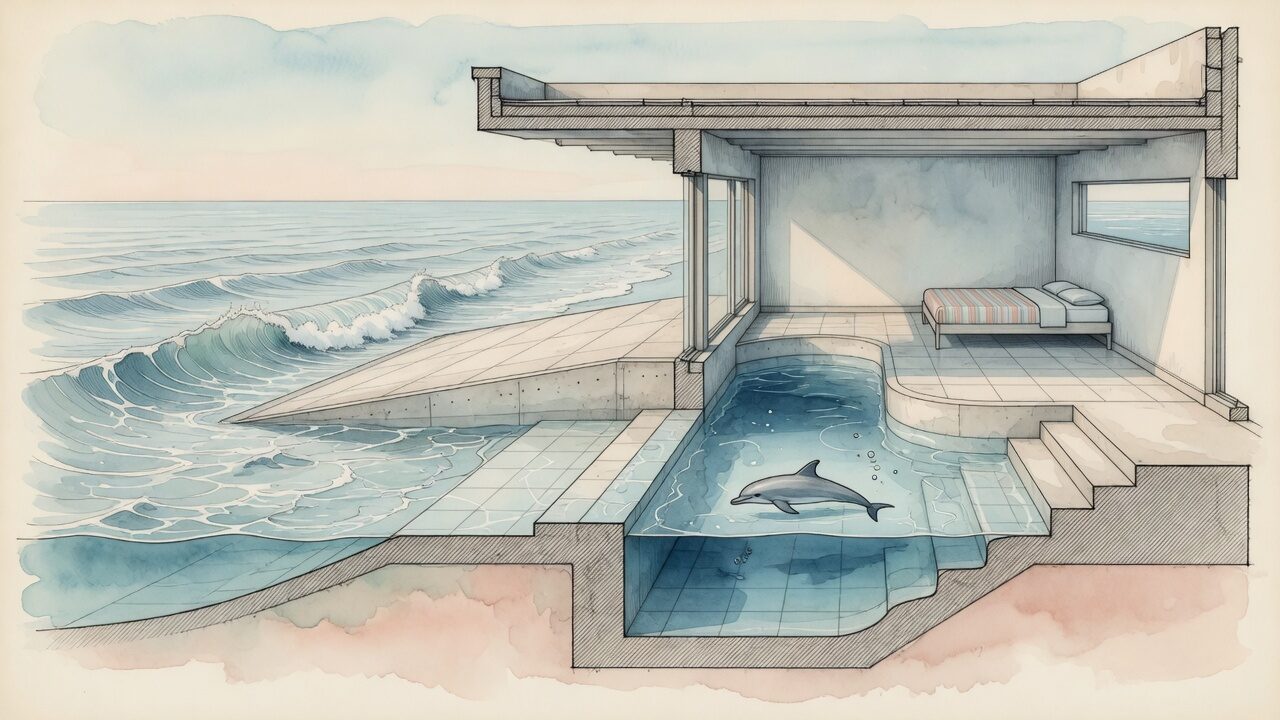
The building hung over a sea pool, flushed clean by the tide. To make the upper floor livable for a dolphin she sealed the rooms watertight and let the ocean in through a wave-ramp — incoming waves channeled up onto the balcony, flooding it to a depth of eighteen inches. The water changed itself every two hours by wave and tidal action; Lilly’s own design notes preferred that natural flow to electric pumps. In the tropics the sea is already dolphin-warm, so nothing had to be heated.2
The genius was in the zoning. The flooded floor had a deep zone where Peter could swim and rest, and a shallow zone — what Lilly called the zone of encounter of man and dolphin, the mutually adapting area — shallow enough for a person to walk, deep enough for a dolphin to swim. That eighteen-inch shallows is where Margaret lived. A dry platform held her bed. The deep end opened toward the sea; the dry end, in Lilly’s phrase, opened toward “all of civilization on dry land.”2
She did not build a pool. She let the sea into the house at the one depth where a person and a dolphin can stand in the same room.
The Teaching
The goal was a sentence: Hello Margaret. Twice a day she ran the lessons, on quarter-inch tape, coaxing Peter to shape human sounds through his blowhole. The hardest was the M — the first letter of her name. He worked at it harder than anything else, eventually rolling onto his side to bubble it up through the water.1
But the lessons were never the point, and she knew it. What taught her the most was the time in between — the long, undirected hours of simply being legible to each other. She was not training a parrot. She was building coherence: a shared channel two different kinds of mind could both read. The same thing Lawrence Anthony built with elephants, across a different gap.
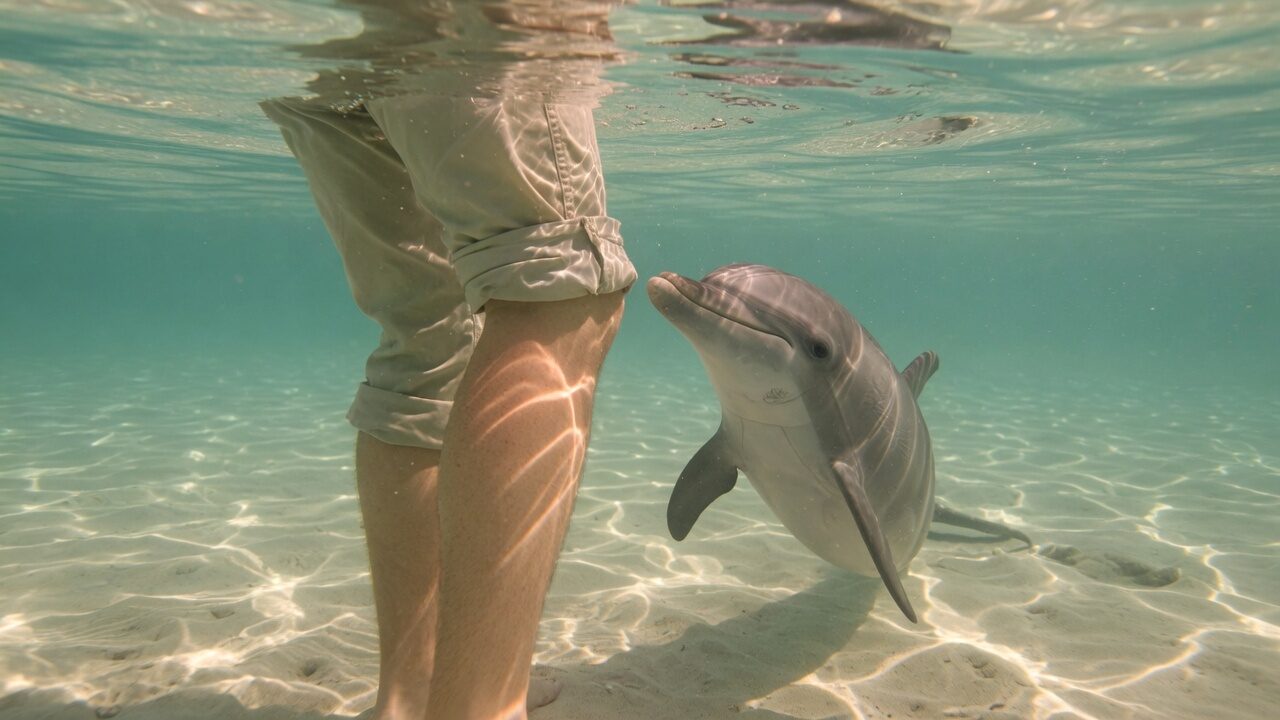
“He was very, very interested in my anatomy,” she remembered. “If my legs were in the water, he would come up and look at the back of my knee for a long time. He wanted to know how that thing worked, and I was so charmed by it.”1
The Closeness
Peter was an adolescent male, and his arousals kept interrupting the work. At first she would send him downstairs to the females; but moving him broke the continuity of the lessons. So she decided it was simpler to relieve him herself, by hand. She was matter-of-fact about it, and never private — people could watch.1
“I wasn’t uncomfortable with it, as long as it wasn’t rough,” she said. “It would just become part of what was going on, like an itch — just get rid of it, scratch it and move on. It wasn’t sexual on my part. Sensuous perhaps. It seemed to me that it made the bond closer. Not because of the sexual activity, but because of the lack of having to keep breaking.”1
What grew, over the weeks, was harder to file. “That relationship of having to be together,” she said, “sort of turned into really enjoying being together, and wanting to be together, and missing him when he wasn’t there.” Then she reached for the word and could not find a safe one.
“I did have a very close encounter with — I can’t even say a dolphin again — with Peter.”
The Man
The lab belonged to John C. Lilly, a neuroscientist who had spent his life on a single question: is there another kind of mind, and can we reach it?
He began at the other end of it. He joined the National Institute of Mental Health in 1952 and mapped living brains with electrodes; he invented the isolation tank there, first as sensory-deprivation research. In the late 1950s he wrote a classified paper on the behavioural control of “human agents” — arguing that isolation, electrical stimulation, and brain mapping could one day yield push-button control of motivation, even, in his words, “master-slave controls directly of one brain over another.” His isolation findings were later cited in the C.I.A.’s interrogation doctrine.3
Then he flipped. He spent the rest of his life arguing the opposite — that isolation tanks and psychedelics were tools the individual could use to resist control and keep their own mind. The dolphins were the hinge. A bottlenose has a brain comparable to ours in size and, by some markers of self-aware sociality, older than ours by millions of years.4 If he could open a channel to it, he would prove a non-human mind could be reached at all.
That is why NASA paid for a dolphin lab. Frank Drake and Carl Sagan — the founders of the search for extraterrestrial intelligence — called themselves the Order of the Dolphin. To them the dolphin and the alien were the same problem: a rehearsal for first contact. Lilly’s stated endgame was a seat for cetaceans at the United Nations. He was not doing marine biology. He was doing first contact.1
And he was injecting the other two dolphins with LSD, curious what it would do. Margaret refused to let him give it to Peter, and he agreed. But they were his animals, in his lab, and she was a young woman with no standing to stop the rest.1
He spent his life trying to talk to a non-human mind, and could not recognize the one already in the room with him.
The Collapse
It ended for ordinary reasons. The LSD took over Lilly’s attention — the slow language work, in her words, “didn’t have the zing” — and the serious people left. The controlled experiment the astronomers actually wanted, one dolphin teaching another a task by sound, was never done. Bateson walked out over the animals’ welfare. The funding was cut. The lab closed in 1966.1
Without money there was nowhere for Peter to go but Lilly’s other lab — a tank in a disused bank building in Miami, smaller, with little or no sunlight. Margaret could not keep him. “If he’d been a cat or a dog, then maybe,” she said. “But not a dolphin.” She shipped him away and stayed behind to decommission the building.1
A note on the record. The sexual detail did not surface publicly until the late 1970s, when Hustler ran a salacious, illustrated version — more than a decade after the lab was already gone. It is what tagged the project “the worst experiment in the world.” It had nothing to do with why the lab closed. The lab closed over drugs, results, and money.1
The Last Breath
In the Miami tank, in the dark, Peter deteriorated quickly. A few weeks later Margaret got the call. By the only account we have — hers, and Lilly’s words on the phone — Lilly told her Peter had committed suicide.1
A dolphin can do that. Every breath one takes is a conscious decision, not a reflex. If living becomes unbearable, it can simply decline to take the next breath. The contract Margaret had built — the coherence, the recognition, the long hours of being legible to one another — was real to him. When it broke, and he was left in a sunless tank with no version of it to return to, he withdrew his consent the only way he could.1
She is calm about it now, fifty years on. “I wasn’t terribly unhappy about it. I was more unhappy about him being in those conditions than not being at all. He wasn’t going to hurt, he wasn’t going to be unhappy, he was just gone. And that was OK. Odd, but that’s how it was.” She married the lab’s photographer, moved back into the flooded building, and raised three daughters there.1
He worked harder on the M than on any other sound — the first letter of her name. What was he saying when he stopped?