Before the analysis, the recordings themselves. Since 1991, NOAA hydrophones have caught sounds rising from the Southern Ocean near Antarctica — most explained as ice grinding against the seafloor, one of them never explained at all. Each clip is sped up 16–20× to lift ultra-low frequencies into human hearing.
35+
Years of Upsweep
600+
Sealed Subglacial Lakes
207+
Subglacial Volcanoes
0
Explanations for ANITA
UpsweepUnexplained
1991 — Present~54°S 140°W20×
Continuous for 35+ years, with seasonal peaks each spring and fall. Near volcanic seismicity but never confirmed. Declining in amplitude, never stopping. Audible across the entire Pacific.
The BloopIcequake
Summer 1997Near Antarctica16×
The most famous ocean sound — so loud it was detected 5,000 km apart. Matched to ice calving in 2012, after 15 years filed as “unexplained” because its profile didn’t fit known icequakes.
Slow DownIceberg
May 19, 1997~62°S 60°W16×
Frequency descends over seven minutes as a massive iceberg grinds to a halt on the seafloor. Detected at ranges of nearly 5,000 km.
JuliaIceberg
March 1, 1999Near Antarctica16×
A large iceberg running aground — the groan of billions of tons of ice meeting immovable rock.
TrainIceberg
March 4, 1997Ross Sea, Cape Adare16×
An iceberg dragging its keel across the seafloor at a steady 32–35 Hz, named for its locomotive rhythm — recorded above some of Antarctica’s most active subglacial terrain.
WhistleVolcanic
July 7, 1997Source uncertain16×
A single undulating tone matching actively erupting submarine arc volcanoes. Caught on only one sensor, so its origin stays uncertain — kin to signals from the Mariana arc, 14,000 km away.
Harmonic TremorIceberg
Antarctic waters3×
Ice in contact with the seafloor or another berg, ringing in harmonic overtones at 40 Hz intervals — a frozen bell the size of a city.
CalvingIceberg
Tracked iceberg A533×
A large section fracturing off a drifting iceberg — millions of tons of ice shattering, exposing what has been sealed beneath for millennia.
I. The Recording
Lake Baikal, February 2026
Someone places a microphone on a frozen lake in Siberia. The ice is between one and one-and-a-half meters thick.
For 22.18 seconds, the recording captures what frozen water sounds like when left to speak for itself.
Lake Baikal — the oldest lake on Earth (25 million years), the deepest (1,642 meters),
holding 20% of the world’s unfrozen fresh surface water. When its ice sheet flexes, cracks,
and resonates, it produces sounds that have nothing to do with music, nothing to do with human culture,
nothing to do with any tuning standard ever proposed.
We ran the audio through spectral analysis. What we found changes the conversation about frequency, tuning,
and what “natural” actually means.
22.18
Seconds of ice
44.1 kHz stereo, 16-bit PCM. Dynamic range: 22.9 dB. Peak amplitude near clipping during the boom event.
0.0066
Spectral flatness
Nearly pure tonal content. This is not noise — these are discrete frequencies produced by physics, not randomness.
220
Onset events
Individual acoustic events detected across 22 seconds. Average: 10 per second. The ice never stops speaking.
II. The Spectrum
Full Spectral Analysis
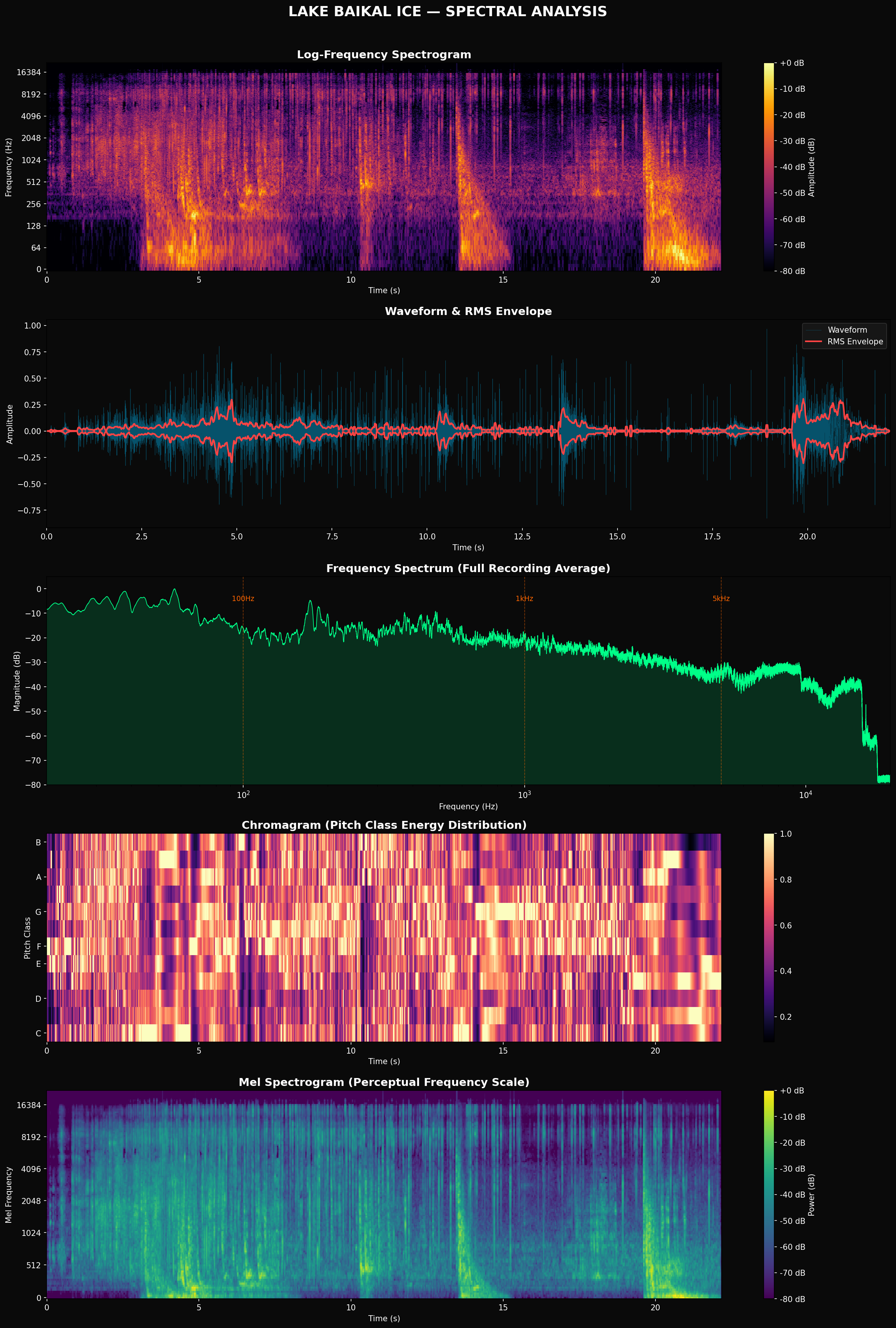
The spectrogram reveals three distinct acoustic signatures layered on top of each other:
deep sub-bass thuds, mid-range tonal peaks, and high-frequency chirps sweeping downward.
The energy distribution tells its own story.
Frequency Band Energy
24.9%
Sub-bass · 20–60 Hz
The ice sheet’s fundamental mode. A quarter of all energy lives below 60 Hz — felt, not heard.
21.1%
Bass · 60–250 Hz
Compressional wave territory. Dominant peak at 59.2 Hz (A♯1) with 38.6 dB of power.
22.7%
Mid · 500–2000 Hz
The densest harmonic region. Where the ice’s overtone series produces its richest interval relationships.
17.6%
Low-mid · 250–500 Hz
Transition zone between compressional thuds and flexural chirps. Peaks at 484.5 Hz (B4) and 425.3 Hz (G♯4).
III. Three Wave Types
The Physics of Ice Sound
Ice is a dispersive medium: higher frequencies travel faster than lower ones. This single physical fact
produces all three sound signatures captured in the recording.
Flexural (Bending) Waves
“Star Wars laser”
200 – 8,000+ Hz
A broadband impulse produces descending chirps — highs arrive first, lows sweep in behind.
Same physics as magnetospheric “whistler” radio waves heard through the Van Allen belts.
The chirps that make Baikal sound like science fiction.
Compressional Waves
Deep thuds
20 – 200 Hz
Non-dispersive, constant velocity (~3,500 m/s in freshwater ice).
Dominant resonance at 59.2 Hz (A♯1), secondary at 172.3 Hz (F3).
The structural voice of the ice sheet itself. Felt in the chest.
Surface Crazing
Tinkling glass
4,000 – 12,000+ Hz
Broadband impulse with rapid exponential decay. Thermal contraction
fractures in the surface layer. 220 individual onset events in 22 seconds —
a continuous crackling that sounds like breaking crystal.
FLEXURAL DISPERSION EQUATION
v(f) = √(2πf · h · √(E / 12ρ))
Euler-Bernoulli beam theory — velocity depends on frequency, ice thickness (h), and elastic modulus (E)
IV. The Boom
19.0 – 21.5 Seconds
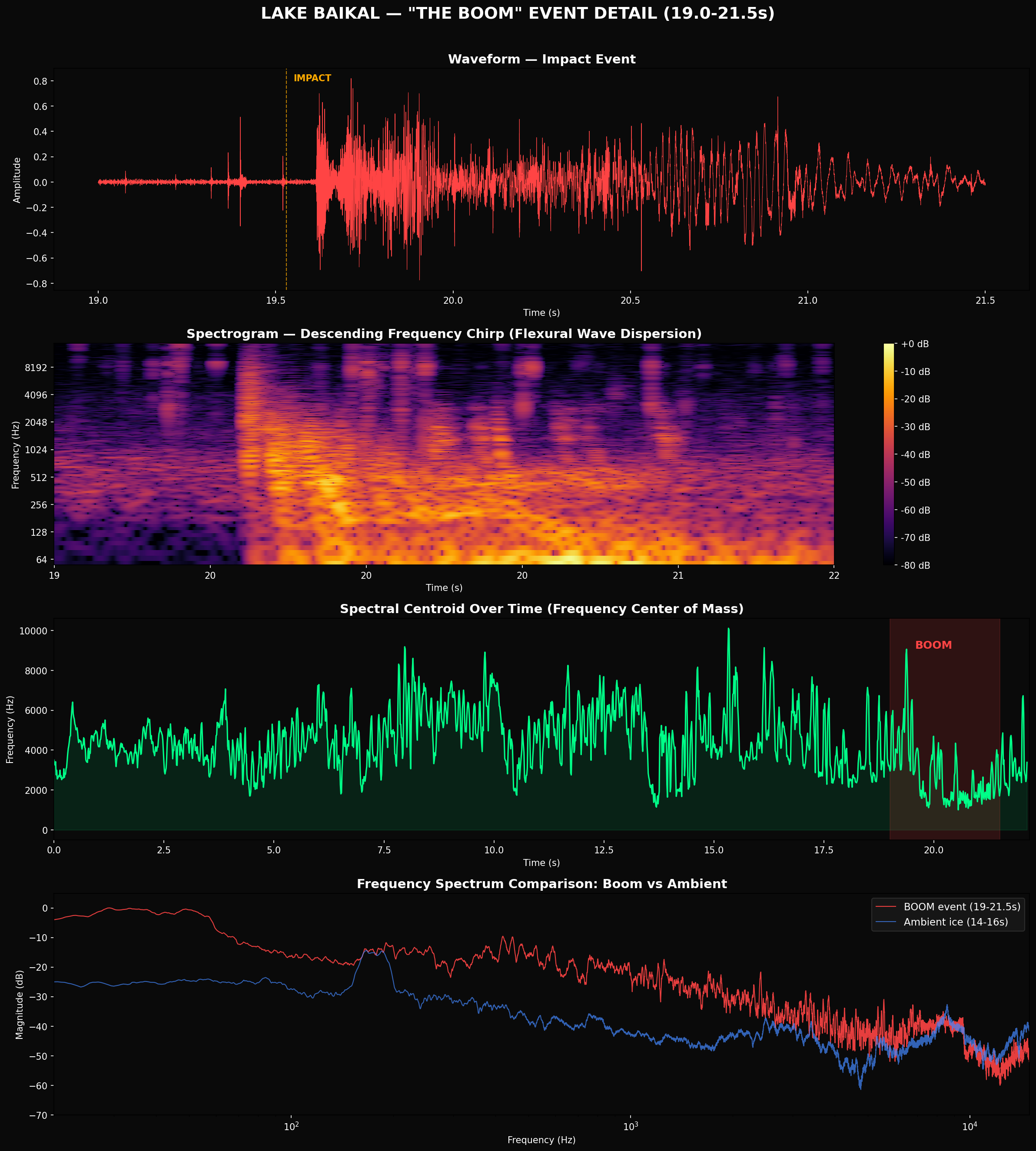
At 19 seconds into the recording, something happens. A structural event — a crack propagating
through the ice sheet — produces a combined compressional thud and flexural dispersion tail
that nearly maxes out the recording.
0.82
Peak amplitude
−1.7 dBFS. Nearly clipping. This single event is 15 dB louder than the ambient ice activity around it.
37.7 Hz
Dominant frequency · D1
Pure sub-bass at 43.2 dB. The fundamental resonance of the ice sheet during the structural event.
−2,090
Chirp rate · Hz/second
The spectral centroid sweeps from 9,948 Hz down to 2,310 Hz — nearly four octaves of descending chirp in 2.5 seconds.
V. The Intervals
Perfect Ratios from Physics
We computed the frequency ratios between all 12 strongest resonant peaks and compared them
to just intonation intervals. The results are not subtle.
The ice produces perfect musical intervals — not approximations, not close enough. Exact.
0.00%
Minor Third · 6:5
376.8 Hz → 452.2 Hz. Exact ratio: 1.2000. Expected: 1.2000. Zero deviation. The ice produces a mathematically perfect minor third.
0.00%
Major Second · 9:8
430.7 Hz → 484.5 Hz. Exact ratio: 1.1250. Expected: 1.1250. Zero deviation. An exact whole tone from frozen water.
0.25%
Perfect Fifth · 3:2
352.6 Hz → 530.3 Hz. The most consonant interval in all of music, produced by a frozen lake at a quarter of one percent deviation.
All Interval Matches
Interval
Ratio
Frequencies
Deviation
Minor Third
6:5
376.8 → 452.2 Hz
0.00%
Major Second
9:8
430.7 → 484.5 Hz
0.00%
Perfect Fifth
3:2
352.6 → 530.3 Hz
0.25%
Perfect Fourth
4:3
263.8 → 352.6 Hz
0.26%
Perfect Fifth
3:2
175.0 → 263.8 Hz
0.51%
Octave
2:1
263.8 → 530.3 Hz
0.51%
The frozen lake does not approximate musical intervals. It produces them with a precision
that exceeds most instruments built by human hands.
Golden Ratio & Fibonacci
The resonant frequencies also align with powers of φ (1.618034…) and Fibonacci sequence numbers.
0.36%
φ² match
185.7 Hz → 484.5 Hz. Ratio: 2.6087. Expected φ²: 2.6180. The golden ratio squared, from ice.
0.90%
φ match
263.8 Hz → 430.7 Hz. Ratio: 1.6327. Expected φ: 1.6180. The golden ratio itself, within one percent.
0.04%
Fibonacci hit · F(14)
376.83 Hz. The 14th Fibonacci number is 377. The ice hits it at four hundredths of one percent deviation.
VI. The Test
440 Hz vs 432 Hz vs 436 Hz
We tested all 30 resonant peaks against three tuning systems — concert pitch (440 Hz),
the Verdi/natural standard (432 Hz), and Baroque pitch (436 Hz) — measuring how many peaks
fall within 50 cents of each system’s harmonic series.
Tuning System
Reference A
Close Matches (<50¢)
Avg Deviation
Verdict
Concert Pitch
440 Hz
7 / 30
210.6 cents
Not privileged
Verdi / Natural
432 Hz
5 / 30
210.3 cents
Not privileged
Baroque
436 Hz
4 / 30
209.5 cents
Not privileged
0
Peaks at 440 Hz
440 Hz is not a resonant frequency of the ice. The nearest peaks are 430.7 Hz and 452.2 Hz. The ice skips 440 entirely.
0
Peaks at 432 Hz
432 Hz is also not a resonant frequency. The same nearest peaks bracket it: 430.7 and 452.2. No special relationship.
10/12
Harmonic series fit
Best-fit fundamental: 20.0 Hz. Ten of twelve strongest peaks fit integer multiples. The ice has its own key — and it isn’t A.
Neither 440 Hz nor 432 Hz is “nature’s frequency.” Nature doesn’t tune to A.
It tunes to itself — and the result is just intonation,
not any particular reference pitch.
VII. What the Ice Proves
Music Theory Didn’t Invent Intervals
A frozen lake in Siberia produces perfect fifths, exact minor thirds, and Fibonacci frequencies
without any awareness of Pythagoras, Verdi, or ISO standards. The harmonic series emerges from
Euler-Bernoulli beam modes — the physics of a vibrating plate.
Just intonation — the system of pure frequency ratios (3:2, 5:4, 6:5) — is not a human invention.
It is a physical law. Wherever matter vibrates, these ratios appear. Music theory didn’t create them.
It discovered them.
THE ICE EQUATION
Vibrating matter → harmonic series → just intonation
No instrument builder. No tuning fork. No culture. Just physics.
The debate was never 440 vs 432.
The question is: why did we stop listening to the intervals?
VIII. What Lies Beneath
What You’re Not Hearing
The recordings are the audible layer. Beneath them sit signals that instruments register but ears cannot — energy, magnetism, and biology that have no settled explanation.
The ANITA Anomaly
In 2016 and 2018 a NASA-funded balloon experiment detected energy bursts rising from beneath the Antarctic ice at 0.6 exaelectronvolts — signals coming up through the Earth at angles the Standard Model calls impossible. The Pierre Auger Observatory searched the rest of the planet for fifteen years and found zero. Around forty physics papers; none explain it.
ANITA Event Summary
ANITA-I (2006): 1 anomalous upgoing event at 27° below horizon
ANITA-III (2014): 1 anomalous upgoing event at 35° below horizon
Energy: 0.6 EeV · Duration: ~1 ns · Chord through Earth: 6,000–7,000 km of solid rock
Survival probability (Standard Model): < 10⁻⁶ · Papers: ~40 · Explanations: 0
PUEO (10× more sensitive) flew Dec 2025 · 50–60 TB collected · results expected early 2027
The Biology
When researchers sampled Mercer Subglacial Lake in 2025, of 1,374 single-cell genomes isolated only one could be identified to species level. The other 1,373 were novel; 147 couldn’t be compared to any of the 317,542 reference genomes in existence — their own branches on the tree of life. Lake Vostok, sealed for up to 15 million years, carries an unexplained 105×75 km magnetic anomaly on its eastern shore.
There are 600+ subglacial lakes. Only two have been cleanly sampled.
Thwaites Glacier sheds fifty billion tons of ice a year, and it is accelerating. Whatever the ice has been keeping will be exposed within decades.