
The Recording
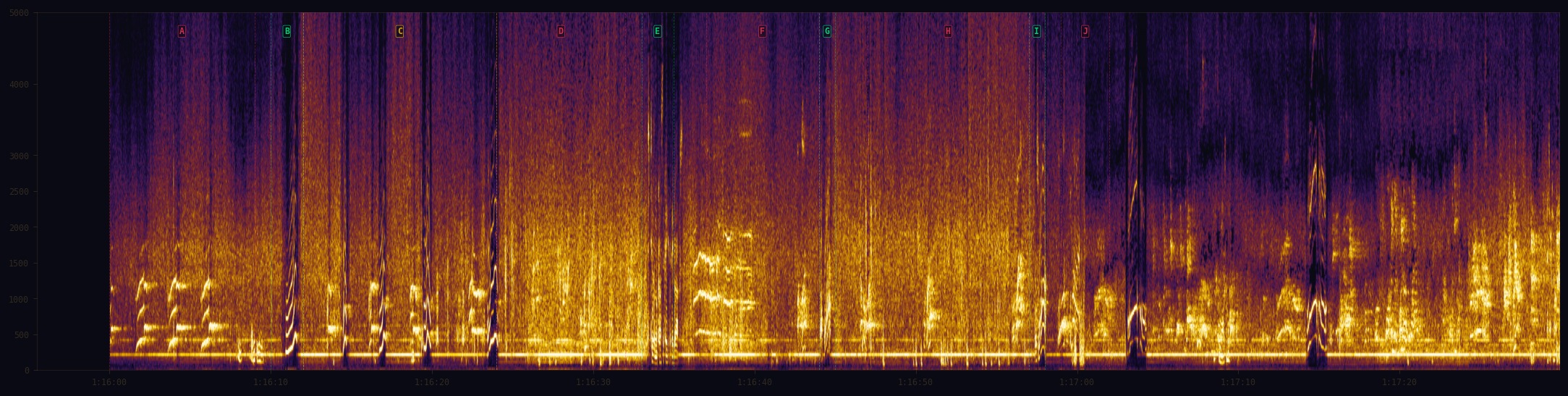
In the fall of 1971, deer hunters Ron Morehead and Al Berry returned to the Sierra Nevada mountains with a reel-to-reel tape recorder. For three consecutive years, something had been visiting their remote camp at night — something that vocalized in ways none of them could explain. What they captured on magnetic tape became the most analyzed anomalous field recording in history.
The recordings were submitted to Dr. R. Lynn Kirlin at the University of Wyoming's Department of Electrical Engineering. His peer-reviewed analysis, published in the university's proceedings, concluded that the vocalizations could not have been produced by a human vocal tract — even with electronic manipulation.
Key Findings
-
Formant Dispersion Rules Out Human Production
The non-human vocalizations show formant spacing consistent with a vocal tract approximately 50% longer than a 6-foot adult male — implying a creature roughly 7 feet 8 inches tall. Speed alteration of a human voice would shift all formant ratios uniformly; these do not.
-
Multiple Distinct Vocalizers
Clustering analysis of fundamental frequency and formant patterns reveals at least 3 distinct non-human vocalizers — each with unique vocal tract characteristics. This eliminates the possibility of a single individual using voice modification.
-
The Speed Alteration Test Fails
If these sounds were human voices played at altered speed, the F2/F1 and F3/F2 ratios would remain constant (speed changes frequency but preserves ratios). The ratios between human and non-human segments are fundamentally different, ruling out tape manipulation.
-
Real-Time Interaction
The recording captures call-and-response exchanges between human and non-human vocalizers with natural conversational timing — responses within 0.5 to 2 seconds. This rules out post-production editing or overdubbing.
Jan’s BlackBerry Encounter
In Missing 411: The Hunted, researcher David Paulides interviews Jan, a woman who describes a face-to-face encounter near a blackberry thicket in the Pacific Northwest. What she describes — the size, the vocalizations, the intelligence in the eyes — aligns precisely with what the spectral analysis implies: a large, intelligent creature with a vocal apparatus significantly different from any known primate.
Jan’s account is significant because she is not a researcher, not a believer, not seeking attention. She is a witness describing a physical encounter with something that, according to the acoustic evidence, has a vocal tract 50% longer than any human on Earth.
The Connection
The Sierra Sounds recording is not an isolated anomaly. It sits at the intersection of multiple Magna Historia research threads: the Missing 411 disappearance clusters that concentrate in the same wilderness corridors, the electromagnetic anomalies detected at sites where encounters are reported, and the indigenous oral traditions that describe these beings with matter-of-fact consistency across unconnected cultures spanning thousands of years.
The spectrogram does not lie. The formants do not lie. The math does not lie. Something was in those mountains in 1971, and the acoustic fingerprint it left behind tells us it was not human.