Pillar I

The Context

"History begins at Sumer."

The oldest extensive written record on Earth—cuneiform tablets spanning creation, catastrophe, and renewal—examined through comparative mythology, textual criticism, and archaeological correlation.

A Three-Part Investigation

Something happened at the beginning of recorded history that we have not fully explained. Civilizations appeared simultaneously, carrying the same knowledge, telling the same story, building with the same mathematics — across oceans they had no means to cross. These three readings approach that question from three directions: the oldest written record, the physical evidence it left behind, and the systems it built that we have since forgotten how to replicate.

Pillar I The Context The Origin Archive

The Sumerian account of human origins — what the first literate civilization wrote on clay tablets 5,000 years ago, and why the same story appears in every culture that followed.

Pillar II The Pattern The Evidence Grid

Four independent lines of evidence — temporal, geographic, mathematical, statistical — that converge on a single conclusion the conventional record has not adequately addressed.

Pillar III The Continuity Living Architecture

The guild systems, craft economies, and community structures that built things meant to last — and the specific decades in which they were systematically replaced.

Chapter I: The Textual Record

The Sumerian cuneiform corpus—comprising thousands of tablets from the third and second millennia BCE—contains cosmogonic, theogonic, and flood narratives that predate and parallel traditions across multiple civilizations. What follows is an examination of these texts and the scholarly traditions surrounding their interpretation.

Chapter I

The Pantheon

Methodological note: The cuneiform texts discussed here are religious and literary compositions, not historical documentation in the modern sense. Mainstream Assyriology (Jacobsen, 1976; Lambert, 2013) reads them as mythological literature reflecting Mesopotamian cosmology and social organization. An alternative interpretive tradition, notably Sitchin (1976), reads them as encoded historical accounts. Both frameworks are referenced where relevant; readers should weigh the evidence independently.

The Sumerian pantheon centered on a group of deities called the Anunnaki—literally "those of princely seed" or, in contested translation, "those who from heaven came to earth." They appear across thousands of cuneiform tablets spanning the Sumerian, Akkadian, and Babylonian periods, constituting one of the most extensively documented divine hierarchies in the ancient world (Black & Green, 1992).

The chief deity was Anu, king of the gods, associated with the heavens. His two principal sons, Enlil and Enki, governed complementary domains: Enlil held authority over the atmosphere, agriculture, and civic order; Enki presided over fresh water, craftsmanship, and knowledge. This tripartite structure—sky, earth, water—mirrors cosmological divisions found in Vedic, Egyptian, and Greek traditions, a parallel noted by comparative mythologists including Kramer (1963) and Eliade (1958).

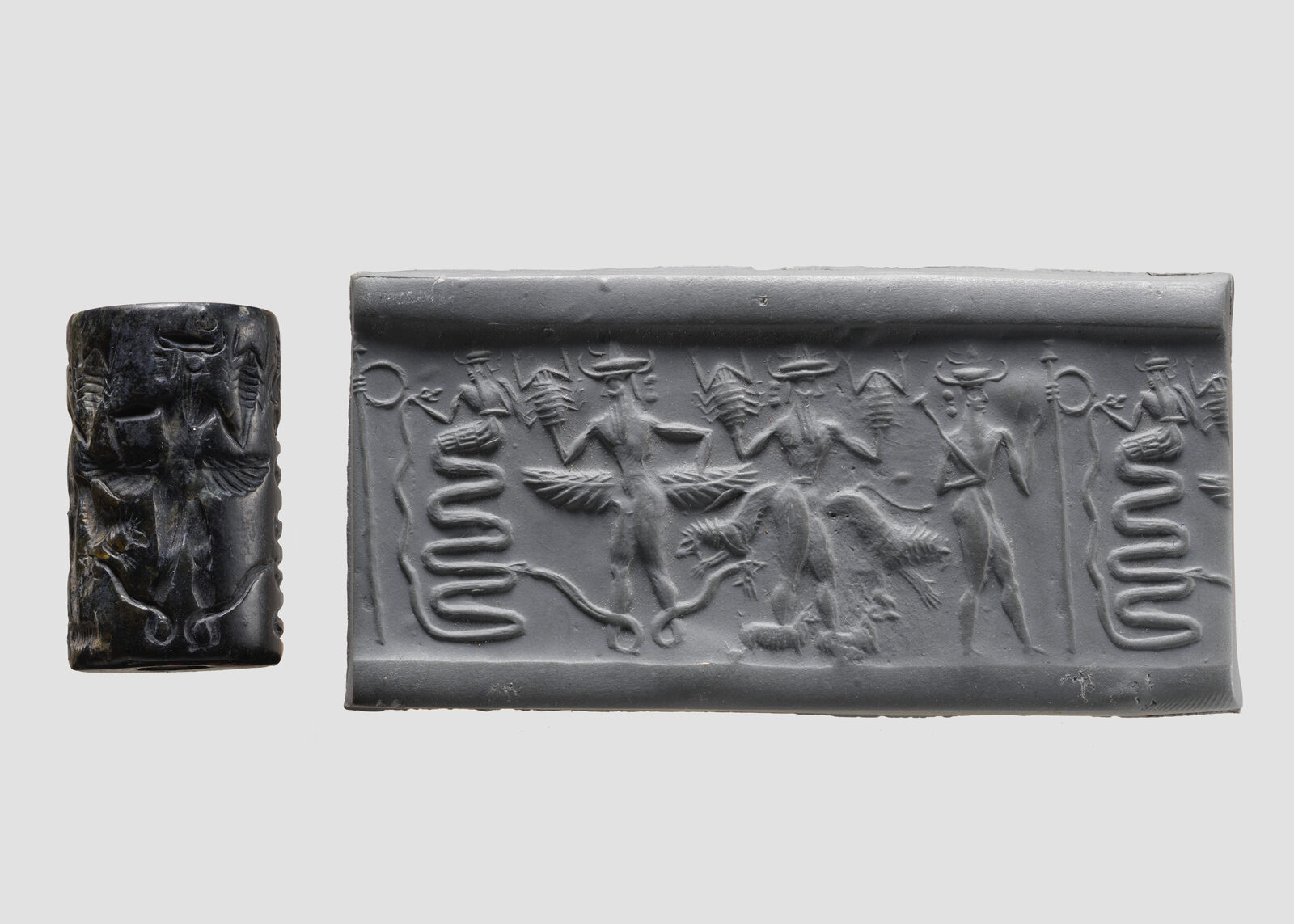
Ancient Sumerian depiction of Anu, king of the Anunnaki
Sumerian cylinder seal depicting Anu, supreme deity and king of the Anunnaki pantheon. Note the horned crown denoting divine status and the symbols of celestial authority.

Within the alternative interpretive tradition (Sitchin, 1976), these texts are read as accounts of extraterrestrial beings who established mining operations in southern Africa. Mainstream scholarship does not support this reading, though it notes that the texts do describe the Anunnaki assigning labor and managing resources—themes consistent with the administrative character of Sumerian temple economies (Postgate, 1992). Archaeological surveys in southern Africa have documented ancient gold mining operations, some with disputed dating extending into deep antiquity (Dart & Beaumont, 1967), though their connection to Mesopotamian narratives remains speculative.

"After kingship descended from heaven, the kingship was in Eridu." — Sumerian King List, c. 2100 BCE

The Sumerian King List (Weld-Blundell Prism, c. 2100 BCE) names the first cities in sequence: Eridu, Bad-tibira, Sippar, Shuruppak. Each is described as having a specific function. Archaeological excavation confirms Eridu as among the oldest continuously inhabited cities in Mesopotamia, with settlement layers extending to the Ubaid period, c. 5400 BCE (Safar, Mustafa & Lloyd, 1981). The King List's antediluvian chronology assigns reign lengths of tens of thousands of years—a feature debated as either symbolic numerology or a product of sexagesimal mathematical convention (Young, 1988).

Chapter II

The Creation

The Atrahasis epic (Old Babylonian period, c. 1700 BCE; critical edition by Lambert & Millard, 1969) opens with a labor crisis among the gods. The lesser deities, assigned to dig canals and maintain irrigation, rebel—burning their tools and surrounding Enlil's dwelling. The council of gods convenes. The resolution: create a substitute laborer.

Enki, god of wisdom and craft, proposes the solution. Working with the birth-goddess Ninhursag (also called Ninmah or Mami), he describes a procedure combining clay with the blood of a slain god to produce lullu—the "mixed" or "primitive" human. The text describes failed attempts producing malformed beings before achieving success. Whether this narrative reflects mythological cosmology, a cultural memory of biological processes, or something else entirely is a question each reader must weigh (Dalley, 2000).

Depiction of the journey from Dilmun to Earth
Ancient relief showing the descent from Dilmun (the Anunnaki homeland) to Earth. The winged disc represents their celestial craft.
"The creature whose name you uttered, it exists! Bind upon it the image of the gods." — Enki's proposal, from the Atrahasis Epic

The god slain for this purpose is named Geshtu-e (or We-ilu)—described as possessing temu, intelligence or planning capacity. His blood mixed with clay becomes the substance of human life. The Enuma Elish—the Babylonian creation epic derived from earlier Sumerian sources—echoes this theme: humans are created to bear the labor of the gods. This motif of humanity as a created servant species is consistent across Mesopotamian literary traditions (Heidel, 1951).

Textual scholars have documented extensive parallels between the Mesopotamian creation narratives and the Hebrew Genesis account, which postdates them by over a millennium. The Sumerian word TI means both "rib" and "life"—a bilingual pun that Kramer (1963) identified as a likely source for the Genesis account of Eve's creation. The name Adamu appears in Mesopotamian texts as a term for the first human. These are not speculative connections; they are recognized in mainstream comparative Semitics (Speiser, 1964; Clifford, 1994).

Independently, paleoanthropology dates anatomically modern Homo sapiens to approximately 300,000 years ago (Hublin et al., 2017, based on Jebel Irhoud fossils). The emergence of behavioral modernity—symbolic thought, art, complex language—appears more recently, around 50,000–70,000 years ago. Population genetics identifies a mitochondrial Eve and Y-chromosomal Adam as common ancestors through maternal and paternal lineages respectively—products of coalescent theory, not evidence for a single founding pair. The chronological gap between anatomical and behavioral modernity remains an open question in human origins research (Klein, 2009).

Chapter III

The Flood Decision

The Atrahasis narrative continues with a population crisis. Humanity has multiplied beyond what the gods intended. The text states that humans had become "too noisy"—a phrase interpreted variously as literal overpopulation, social disorder, or ritual negligence (Moran, 1987). Enlil, god of authority and order, responds with escalating punishments: plague, drought, famine. Each time, Enki intervenes on humanity's behalf, teaching counter-measures. The tension between Enlil's desire for control and Enki's advocacy for his creation is the central dramatic axis of the text.

Finally, Enlil decrees a flood to destroy humanity entirely. The council of gods swears an oath of secrecy—no human is to be warned. This narrative structure—divine council, oath of silence, one dissenting god—appears with remarkable consistency across the Sumerian, Akkadian, and Babylonian versions of the flood tradition (George, 2003).

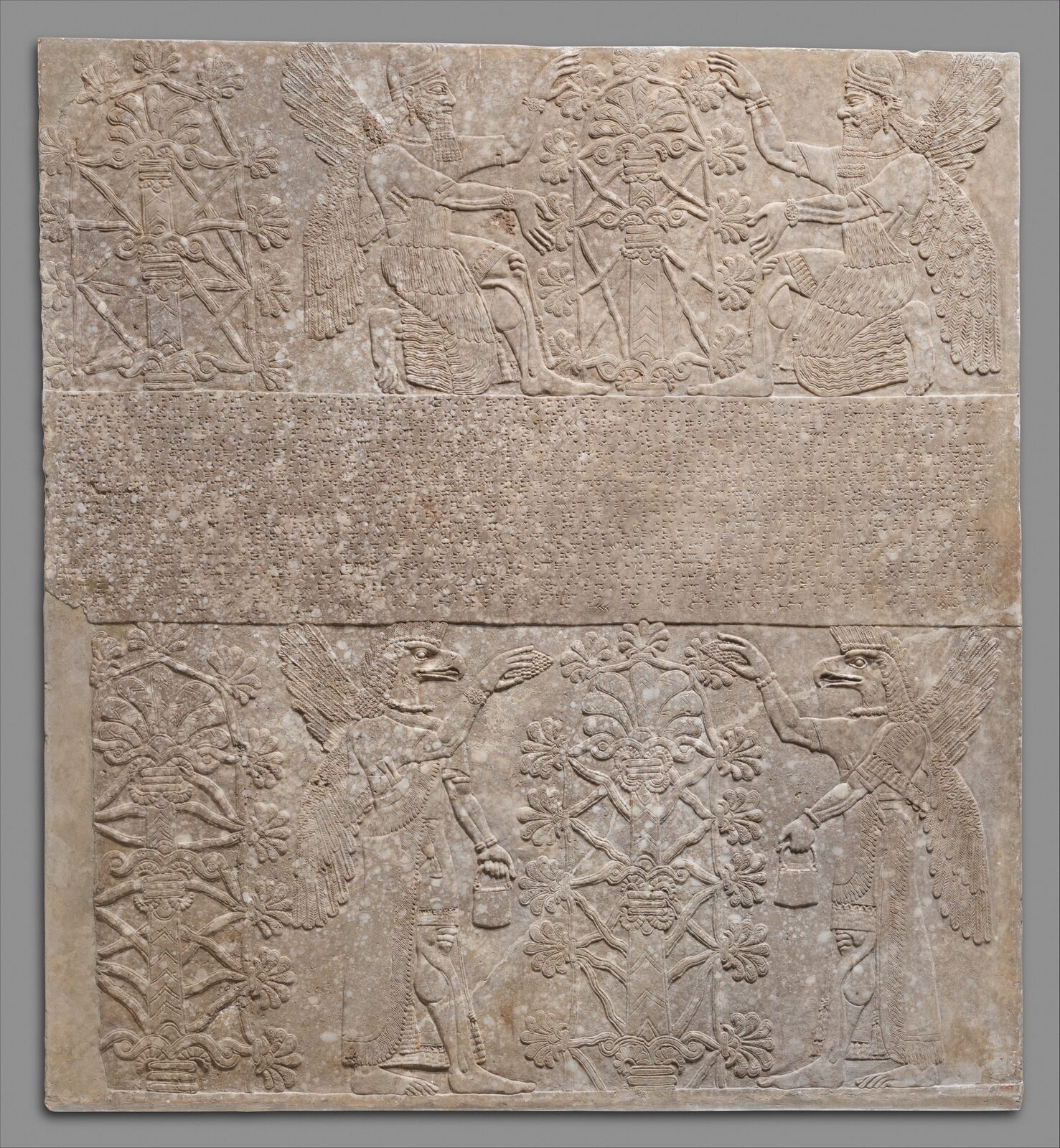
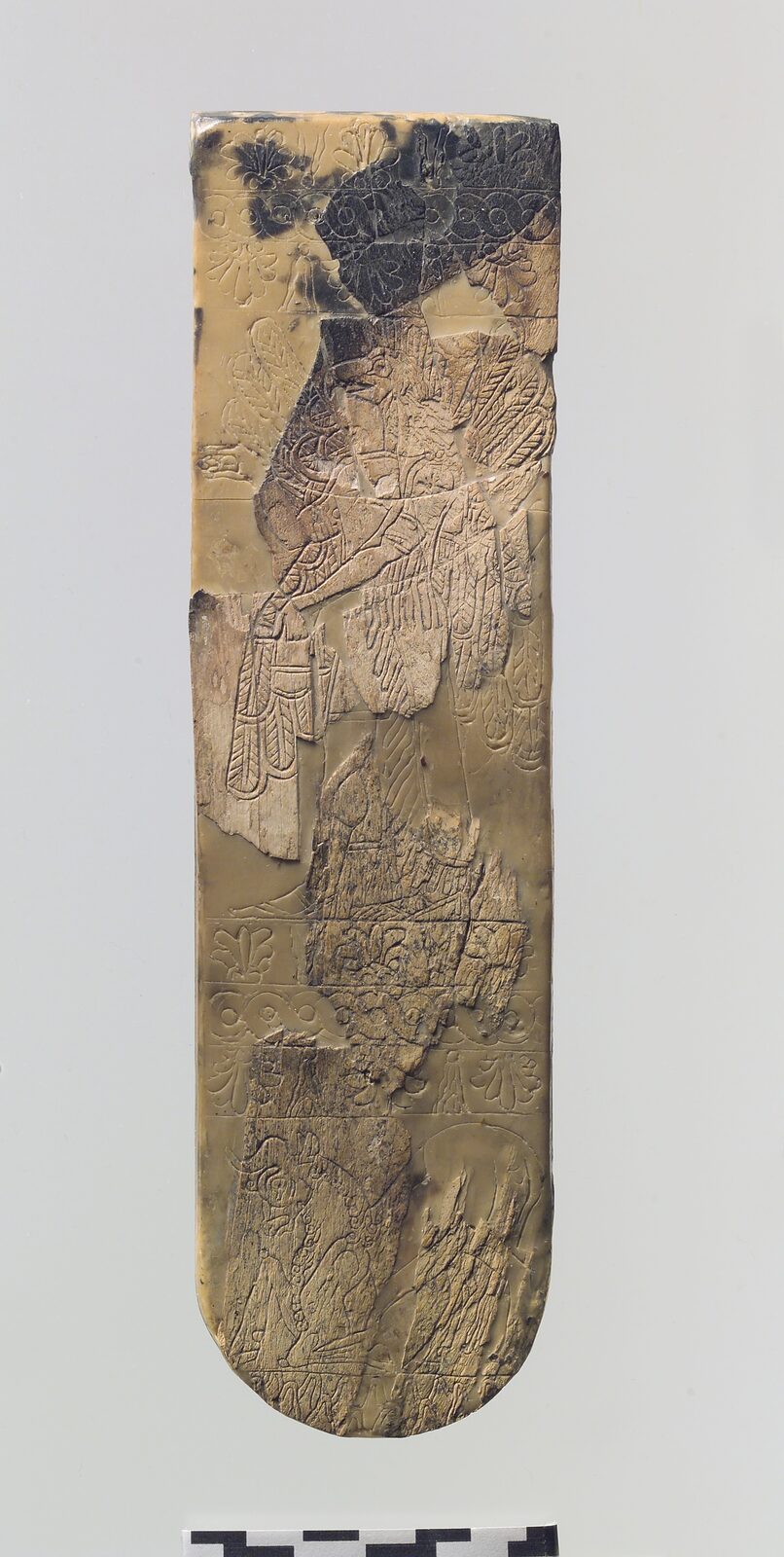
Anunnaki winged figures
Winged Anunnaki figures, symbols of their role as intermediaries between heaven and earth, depicted in ritual blessing pose.
"The secret of the gods do not reveal to him. Let the people perish. Let the noise of humanity be silenced." — Enlil's decree, from the Atrahasis Epic

Enki, bound by the oath, employs a literary device that appears across all versions of the narrative: he speaks not to a human but to a reed wall, knowing that a righteous man—Ziusudra in Sumerian, Atrahasis in Old Babylonian, Utnapishtim in the Epic of Gilgamesh, Noah in Hebrew tradition—is listening on the other side. Through this narrative mechanism, Enki transmits the specifications for a vessel and instructions for preserving life. The detailed measurements given in the Gilgamesh version describe a cube-shaped vessel; those in Tablet XI have been analyzed by naval architects and found to describe a structure with genuine hydrodynamic properties (Finkel, 2014).

The geological record documents a major catastrophic period coinciding with the Younger Dryas (c. 12,800–11,600 BP). Global sea levels rose approximately 120 meters during the post-glacial period, with evidence for episodic rapid pulses (Meltwater Pulse 1A, c. 14,600 BP; Meltwater Pulse 1B, c. 11,500 BP). The Younger Dryas Impact Hypothesis (Firestone et al., 2007; Kennett et al., 2009) proposes a cosmic airburst or impact as a triggering mechanism, supported by a platinum anomaly and nanodiamonds in the stratigraphic record, though this remains debated (Holliday et al., 2023). Whether the Mesopotamian flood narratives preserve cultural memory of these events, local Mesopotamian flooding (documented in Woolley's 1929 Ur excavation), or both, is unresolved.

The post-flood sections of the Sumerian and Babylonian texts describe Enlil's anger at the survivors, followed by a reconciliation in which humanity is permitted to continue under altered conditions. The Sumerian King List marks this transition explicitly: kingship "descends from heaven" again, now to the city of Kish. The theological framework shifts from direct divine governance to mediated human authority—a transition that Jacobsen (1939) identified as reflecting actual political developments in early Mesopotamian city-states.

Chapter IV

The Preservation Protocol

The post-flood narrative raises a question that archaeology has engaged independently: the emergence of complex societies in geographically elevated or isolated locations during the early Holocene. While the textual tradition describes deliberate preservation, the archaeological record can be examined on its own terms.

Several early centers of cultural complexity appear at high-altitude or geographically protected locations in the post-glacial period, each developing sophisticated knowledge systems:

Anunnaki watcher figure
The Watchers: Anunnaki overseers who monitored humanity through the ages, depicted with the symbols of their monitoring technology.

The rapidity of cultural development at several of these sites has prompted scholarly reassessment. Göbekli Tepe, in particular, demonstrates that Pre-Pottery Neolithic communities possessed organizational capacity and astronomical knowledge significantly exceeding what earlier models predicted (Notroff, Dietrich & Schmidt, 2017). The site does not appear ex nihilo—it has antecedents in earlier Natufian culture—but the scale and precision of its monumental construction remain difficult to account for within strictly gradualist frameworks.

"After the flood had swept over, and the kingship had descended from heaven, the kingship was in Kish." — Sumerian King List

The Sumerian King List's post-flood genealogies record "kingship descending from heaven" to specific dynasties—a theological legitimation of political authority that Jacobsen (1939) analyzed as reflecting the transition from temple-based governance to secular kingship. Whether these "divine" genealogies encode actual lineage, political mythology, or something more complex is a question that touches the foundations of how we read ancient sources.

What is documented beyond dispute is the presence of specific mathematical constants in monumental architecture across cultures: the precessional numbers 72, 144, 432, and 25,920 appear in Egyptian, Vedic, Norse, and Mesoamerican traditions. De Santillana and von Dechend (1969), in Hamlet's Mill, compiled extensive evidence that these numbers encode knowledge of Earth's 25,920-year axial precession—a phenomenon requiring centuries of sustained astronomical observation to measure. How this knowledge was acquired and disseminated remains one of the central open questions in archaeoastronomy.

Chapter V

The Universal Echo

The Sumerian flood narrative would be a curiosity of regional mythology if it existed in isolation. It does not. Comparative mythologist Alan Dundes (1988) catalogued over 200 culturally distinct flood traditions worldwide. The structural parallels—divine warning, vessel construction, survival of a chosen family, renewal of civilization—recur with a consistency that has generated sustained scholarly debate about transmission, shared experience, or archetype:

Sumerian
Ziusudra / Atrahasis
Original account. Gods create humans as workers, gods decide to destroy via flood, one god (Enki) secretly warns a chosen man, ark built to specifications, flood destroys civilization, humanity preserved and reestablished.
Akkadian/Babylonian
Utnapishtim
Epic of Gilgamesh version. Essentially identical to Sumerian, with Utnapishtim granted immortality by the gods after surviving the flood. Gilgamesh seeks him out to learn the secret of eternal life.
Hebrew
Noah
Genesis account, written during Babylonian exile when Hebrews had direct access to original tablets. Condensed the polytheistic account into monotheistic framework. Same flood, same ark, same covenant.
Hindu
Manu
First man warned by Matsya avatar of Vishnu (fish god). Flood destroys all of creation, Manu preserves seeds of all life in a boat, becomes sole progenitor of renewed humanity.
Greek
Deucalion
Son of Prometheus (who gave fire/knowledge to humanity). Zeus floods Earth to destroy corrupt Bronze Age humanity. Deucalion and wife Pyrrha survive in a chest, repopulate world by casting stones.
Chinese
Gun-Yu / Nuwa
Great flood controlled by heroic figures with divine assistance. Nuwa repairs the broken pillars of heaven after catastrophe. Gun steals "breathing earth" from the gods to stop the deluge.
Mesoamerican
Coxcox / Tata / Nene
Multiple flood traditions across Maya, Aztec, and earlier cultures. Popol Vuh describes destruction of earlier human creations by flood. Survivors preserve knowledge for next world age.
Australian Aboriginal
Various dreamtime figures
Rainbow Serpent causes world-destroying flood. Sky beings descend to teach survivors how to live. Oral traditions preserved for over 10,000 years with geological accuracy.

The recurring structural elements are: divine or supernatural agency in the catastrophe's cause; advance warning to a chosen individual or family; construction of a vessel or refuge for preservation of life; destruction by water of the existing world order; and renewal of civilization under altered conditions. The sequence is remarkably stable across traditions that, in many cases, had no documented means of contact.

The scholarly explanations for this convergence fall into three principal categories. Diffusionism proposes transmission from a common source along ancient trade and migration routes. Catastrophism argues that the narratives preserve genuine cultural memory of post-glacial flooding events—a position strengthened by geological evidence for rapid sea-level rise and the Younger Dryas impact hypothesis. Structuralism, following Lévi-Strauss (1955) and Jung (1959), proposes that the narrative reflects universal cognitive patterns. These explanations are not mutually exclusive; elements of all three may apply.

"We are dealing here with a basic mythological motif... one that is indeed so widespread that it seems virtually universal." — Alan Dundes, The Flood Myth, 1988

This is The Context—the oldest extensive written record of creation, catastrophe, and civilizational renewal. The Sumerian corpus does not stand alone; it is the most complete textual expression of a narrative tradition documented across every inhabited continent. Modern archaeology, genetics, and geology continue to produce findings that intersect with elements of these accounts in ways that warrant continued investigation.

The next pillar examines the physical evidence—the architectural, mathematical, and astronomical data embedded in ancient monuments worldwide—and asks whether their precision and convergence can be adequately explained by independent development alone.

"The Sumerians produced the oldest extensive written corpus in human history. Their cosmogonic and flood narratives, far from being isolated curiosities, form the earliest layer of a textual tradition that appears across civilizations worldwide. The questions these parallels raise remain open."

Proceed to Pillar II: The Pattern